GO WORLD Business · Nov 19, 2026
The maker of the Claude AI models opened on Nasdaq well above its offer price on Thursday, after raising more money than any company in history. The debut is a landmark for the artificial-intelligence boom — and a test of whether public investors will keep paying for it.
A record offering
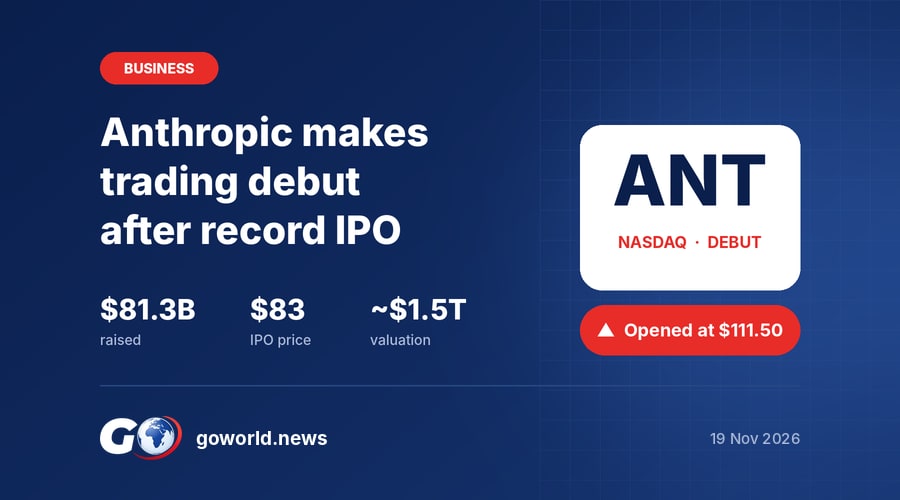
Anthropic, the San Francisco-based developer of the Claude family of AI models, began trading on the Nasdaq on Thursday, 19 November, under the ticker "ANT". Co-founders Dario Amodei, the chief executive, and his sister Daniela Amodei, the president, rang the exchange's opening bell in New York.
The company priced its initial public offering on Wednesday evening at $83 per share, above its marketed range of $70 to $78. It sold 980 million Class A shares — more than the 825 million originally planned — raising $81.3 billion. That makes it the largest IPO on record, ahead of the $75 billion SpaceX raised in June. At the offer price, the deal valued Anthropic at about $1.5 trillion on a fully diluted basis.
Most of the shares, about 956 million, were sold by Anthropic itself, with the remainder sold by existing shareholders. Alongside the IPO, a group of technology companies — AMD, Broadcom, Google, Micron, Microsoft, Nvidia and an affiliate of TSMC — agreed to buy $26 billion of non-voting shares at the same $83 price, bringing the total raised to roughly $107 billion.
A strong first trade
Demand carried over into the open. Anthropic's shares began trading at $111.50, about a third above the IPO price, according to Yahoo Finance, giving the company a market value of around $2 trillion at the opening trade. CNBC reported that retail demand for the offering was the largest on record; reports ahead of the deal said up to a fifth of the shares had been set aside for individual investors.
The broader market was choppy. Nasdaq futures rose sharply before the open, and the tech-heavy index gained early, but US stocks gave back some gains as traders waited for the first Anthropic trade. Protesters also gathered outside the Nasdaq building, a reminder of the public unease that surrounds the rapid spread of AI.
The first frontier AI lab on Wall Street
Anthropic is the first of the leading "frontier" AI developers to list publicly. Founded in 2021 by former OpenAI researchers, it is organised as a public benefit corporation, a legal form that requires directors to weigh a stated public mission — in Anthropic's case, the safe development of AI — alongside shareholder returns. Under the new share structure, Class A shares carry one vote each, while the Class N shares sold to the technology partners carry none, and the company will be treated as a "controlled company" under Nasdaq rules.
The listing gives investors their first direct look at the economics of a frontier lab. Coverage of the company's filings reported third-quarter revenue of about $17 billion, more than twelve times a year earlier, alongside enormous long-term commitments to buy computing power. Rival OpenAI remains private and is reportedly looking at a listing in 2027.
The risks investors are weighing
The enthusiasm comes with questions. Building and running advanced AI models requires vast and growing spending on chips, data centres and electricity, and investors have been questioning the industry's losses, capital spending and eventual returns after weeks of volatility in technology shares.
Analysts cautioned against reading too much into one day. A Truist analyst said the IPO should not be seen as a verdict on AI as a whole, though its reception does signal how much appetite remains for the sector. Some market commentators also noted that a significant number of shares held by insiders could be eligible for sale early, which could add pressure on the price after the first-day rush. Large first-day gains are also a reminder that the company may have left money on the table by pricing below what the market was willing to pay.
Why it matters beyond Wall Street
The size of the raise matters for the global AI race. Capital on this scale goes largely into computing infrastructure, and it strengthens the handful of US companies — and their chip and cloud partners — that already dominate the technology. For governments and businesses in Africa and the Middle East, that concentration shapes everything from the cost of AI services to where data is stored and whose rules apply.
It also raises the stakes of AI governance. A publicly traded Anthropic will face quarterly pressure from shareholders at the same time as it makes the case that safety and commercial success can go together. How it balances those demands will be watched closely by regulators far beyond the United States.
Share prices move quickly; figures in this article reflect reporting at the time of the opening trade. This article is not investment advice.
GO WORLD — goworld.news
Share this story