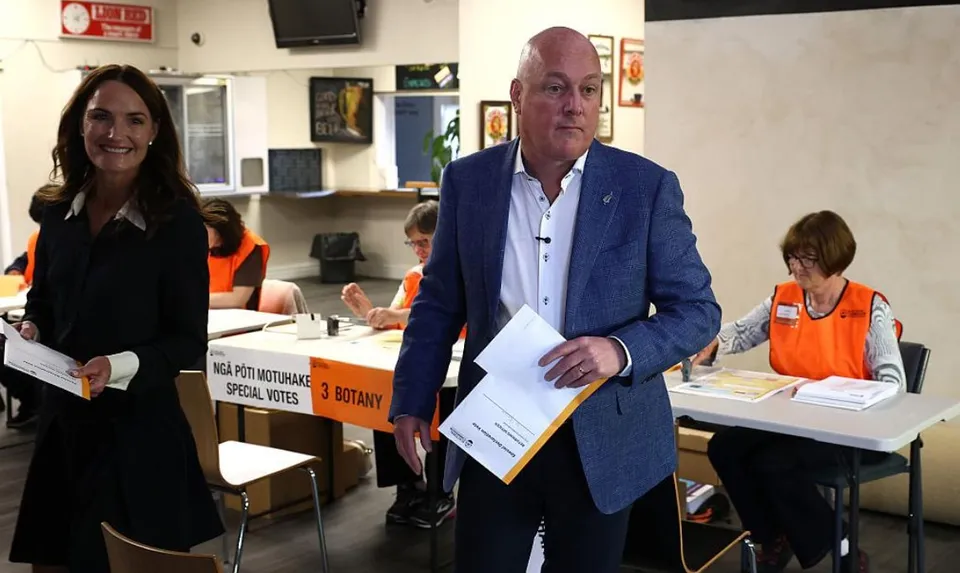
WELLINGTON — New Zealand's general election has produced a closely contested result, with the governing National Party and opposition Labour Party locked in a tight race, leaving smaller political parties potentially decisive in determining the country's next government.
With more than 95 percent of votes counted, Prime Minister Christopher Luxon's National Party and its coalition partners appeared to be narrowly ahead of the opposition bloc led by Labour leader Chris Hipkins, according to preliminary results.
The conservative bloc, comprising National, ACT New Zealand and New Zealand First, was projected to secure 67 seats in a parliament of around 130 members, just above the 66 required for a majority. Labour and its potential partners, the Greens and Te Pāti Māori, were projected to hold 56 seats.
However, hundreds of thousands of special votes remained to be counted, leaving the final parliamentary balance uncertain. Official results are expected on November 27.
The centrist Opportunity Party, led by political newcomer Qiulae Wong, appeared set to enter parliament with seven seats, potentially giving it an influential role in post-election negotiations.
Wong said her party was open to discussions with either political bloc, although Luxon had ruled out forming a government with Opportunity.
The election followed a campaign dominated by economic concerns, high living costs, unemployment and dissatisfaction with the country's political leadership.
Luxon, seeking a second term, campaigned on economic management, restoring a budget surplus and strengthening the country's economy.
Hipkins, meanwhile, focused on easing pressure on households, improving healthcare and investing in housing and public services.
Both major parties faced challenges attracting sufficient support to govern independently, reflecting the growing influence of smaller parties in New Zealand's proportional electoral system.
Under the country's mixed-member proportional voting system, parties frequently need to negotiate coalition agreements or secure support from other parliamentary groups to form a government.
The close result means coalition negotiations could take several weeks, with the outgoing government remaining in a caretaker capacity while the political parties work towards an agreement.
GO WORLD
Share this story